Single Pixels /2021
Single Pixels /2021
Single Pixels NFTs is a schizophrenic artistic research project about pixels and non-fungible token (NFT) art. What started as a satirical comment about the mad NFT hype ended up in a poetic investigation on pixels.
The Madness
Single Pixels NFTs is a collection of digital image files offered for sale on the NFT platform opensea.io. The artworks’ files are just 3 kilobytes in size, and the pixels they contain are many times smaller than the dot at the end of this sentence. They were offered for sale for 1 Etherum (~ 1,500 $) to comment on the current divergence between financial and fundamental valuations. The practical immateriality of the pixels is in absolute contrast to the insane ecological footprint of 125 Kg CO2 caused by minting. Additionally, These sweet little no-things take NFT’s promise of digital authorship ad absurdum: how can one claim ownership of something that has hardly any perceptible properties?
The Poetry
While loading the single pixels into their sales packaging, a digital photo frame key chain, I suddenly remembered my childhood. When I was a kid, I liked to walk so close to the tv until I could only see pixels. I found it totally fascinating how these inherently meaningless pixels could tell the most adventurous stories once they joined for a dance on a screen. Single Pixel NFTs reveals the adaptability and beauty of the omnipresent but rarely noticed building blocks of digitization. A single pixel is barely perceptible. But if you put it on the right screen and get close enough, you can see the world’s smallest sunrise.This sweet little no-thing is able to show everything.
Pixels also serve as a yardstick for the progression of digitization. A pixel has no extension independent of the display that shows it. As our screens evolve, the single pixel is becoming smaller and smaller, until at some point we can no longer perceive it at all – in a metaverse of invisible pixels.

“Single Red and Blue Pixel Edgeways” displayed in Firefox browser.
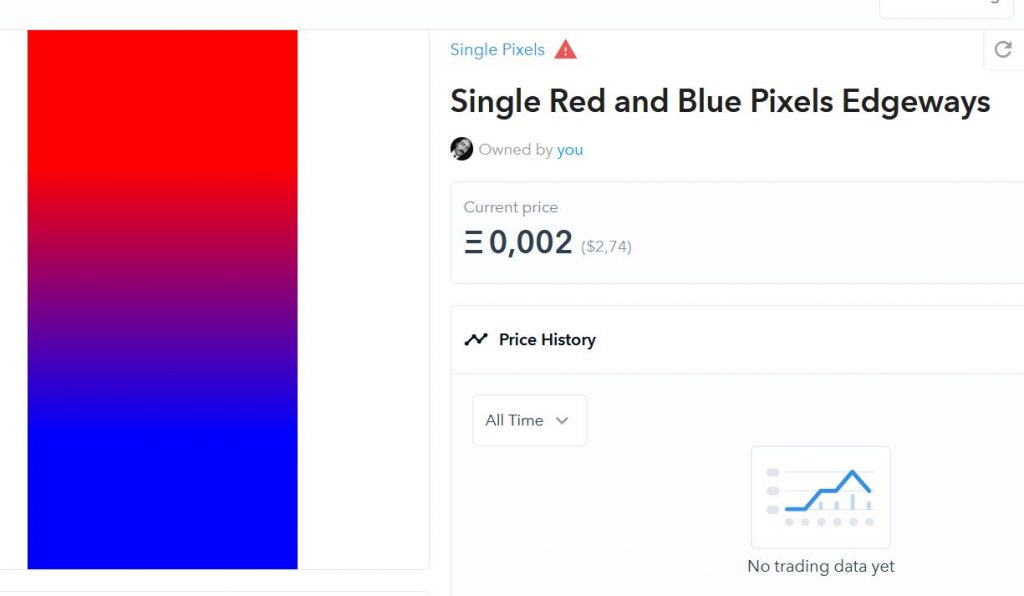
Preview of “Single Red and Blue Pixel Edgeways” on opensea.io.
Single Pixel Collection on opensea.io
Currently applying for three Guinness World Records for “Smallest Artwork” (Ref.: 210226133634sa), “Smallest Digital Artwork” (Ref.: 210226124532sda) and “Smallest Non-Fungible-Token Artwork” (Ref.: 210226140416sna).
Smart Hans /2022
Smart Hans /2022
Once there was a horse with an unbelievable skill. The horse was called “Clever Hans” because it could read people’s minds. The horse could guess any number you were thinking of. For example, if you had the number 84 on your mind, Clever Hans would look at you, tap its foot 84 times, and then stop.
How did Clever Hans do this? Of course, Clever Hans could not actually read your mind. But Clever Hans could analyze body postures. It saw the tension rising in your body when it started tapping, and it noticed the slight, irregular jerk of your head, when it reached your imagined number. This happened 100 years ago. Today, machines can do this too.

Clever Hans reading minds at a fair.
Our Project Smart Hans is a synthetic reincarnation of Clever Hans. The interactive installation shows an animated horse that can guess any number on your mind via posture recognition. This horse is fun to play with but it is also a manifestation of our concerns regarding Artificial Intelligence (AI).
Smart Hans is an intuitive warning about the potential threat of surveillance technology and Artificial Intelligence, which are increasingly being used in the public sphere. In a very personal way it shows the potential of AI to penetrate your most private space, your mind.
The installation manifests the “Clever-Hans-Effect”, which restricts the validity of almost any artificial neural network. Clever-Hans-Effect denominates the general impossibility to determine what a neural network actually learns respectively which data its decisions are based on.
On the other hand, if you play the game often enough, you will automatically become aware of the subtle cues Smart Hans is looking for. By purposefully suppressing or producing these cues any child can learn how to trick this AI.
Team: Anja Borowicz Richardson (UK), Bruce Gilchrist (UK), Akshita Gupta (IND), Max Haarich (Artistic Lead / DE), Martina Huynh (NL), Asad Imtiaz (PAK), Muhammad Qasim Khan (PAK), Adrian Ludwig (DE), Pekka Ollikainen (FI), Raphael Pickl (DE)
Project Smart Hans was incubated during the Deepfake Masterclass at Baltan Laboratories in Eindhoven (NL) under guidance of Ellen Pearlman (US) and Julien Deswaef (NL) from ThoughtWorks Art as well as Leif Czakai (NL) from Baltan Laboratories. The project won the “Super Artistic AI Award” in the category “Interaction” and the jury’s main prize at Lab30 festival 2022. It has been exhibited a.o. at Deutsches Museum, New Now Festival, FILE Festival, Science Gallery, and World Economic Forum.
Gefördert durch die Beauftragte der Bundesregierung für Kultur und Medien.
A Constitution for the Age of AI /2018
A Constitution for the Age of AI /2018
Uzupis is an artist republic founded to save a district from drowning in poverty and violence. With love, humor, and paradox the republic saved the district and the lives of the inhabitants. The constitution of Užupis was the intellectual centerpiece of that peaceful revolution. After an official amendment process I was allowed to add an AI article to the constitution. The AI version of the Užupis constitution is permanently mounted to the wall of a socio-cultural center, which is located right between arts galleries and start-up incubators. The constitution builds a bridge between arts and technology to inspire the AI world with the caring and affectionate worldview of artists.
The formulated article is a subversion of the current ethical debate about AI to remind humans of their self-responsibility. At the same time it grants AI the status of a subject in order to anticipate potential futures of cohabitation with artificially intelligent beings. The AI constitution has been presented on various international exhibitions as well as scientific and political conferences like Ars Electronica and AI4Good, and has been covered by news papers and magazines like Süddeutsche and US Playboy.
Here you can watch the videos of the unveiling ceremony.
Užupis Principles for Trustworthy AI /2019
Užupis Principles for Trustworthy AI /2019
AI as a knowledge processing and decision making technology raises many questions and concerns about how to control it and how to prevent abuse. Current governance structures still try to monitor and sanction the totality of AI applications. The sheer extent and pace of AI adoption renders this approach increasingly insufficient. Therefore, Užupis engages to strengthen the ethical values of each individual, which form the basis of all AI applications. Our constitution‘s Munich right and our Principles for Trustworthy AI Design strongly emphasize our own responsibility.

The Užupis Principles for Trustworthy AI Design shall serve as a complementary to the European Union’s recommendations on trustworthy AI (The Munich Embassy of Užupis is member of the European AI Alliance, which created the EU’s recommendations). These are the first principles, which rely on trust in the people designing AI, support an ongoing process of readjusting the AI, and foster adoption to diverse and dynamic conceptions of ethics. The principles neither certify nor enforce the design of AI for common good. They rather encourage you to stay true to yourself and act responsibly towards others.
http://uzhupisembassy.eu/wp-content/uploads/2019/07/Uzupis-Principles-for-Trustworthy-AI.pdf
Hello world!
Welcome to WordPress. This is your first post. Edit or delete it, then start writing!